Nier: Automata and Shuhei Yoshida sparked a Japanese action-RPG renaissance, reshaping gaming culture and industry legacy.
In the grand, chaotic theater of video game history, few moments resonate with the seismic fury of a tectonic shift. Yet, tucked away in the neon-drenched catacombs of 2017, a title emerged that would not only redefine action-RPG storytelling but – according to none other than former PlayStation emperor Shuhei Yoshida – literally drag the entire Japanese gaming industry back from the brink of irrelevance. Nier: Automata, a game born from the wonderfully twisted mind of Yoko Taro, wasn’t just a critical darling or a cult classic; it was a cultural defibrillator that shocked a floundering creative heart back into a thunderous rhythm. Its impact, often whispered about in awed reverence but rarely screamed from the rooftops, is now being etched into legend by the very architects of the industry. And as 2026 dawns, with the tenth anniversary of this masterpiece looming like a glorious, existential meteor, the ripples of its arrival continue to warp gaming’s very fabric.
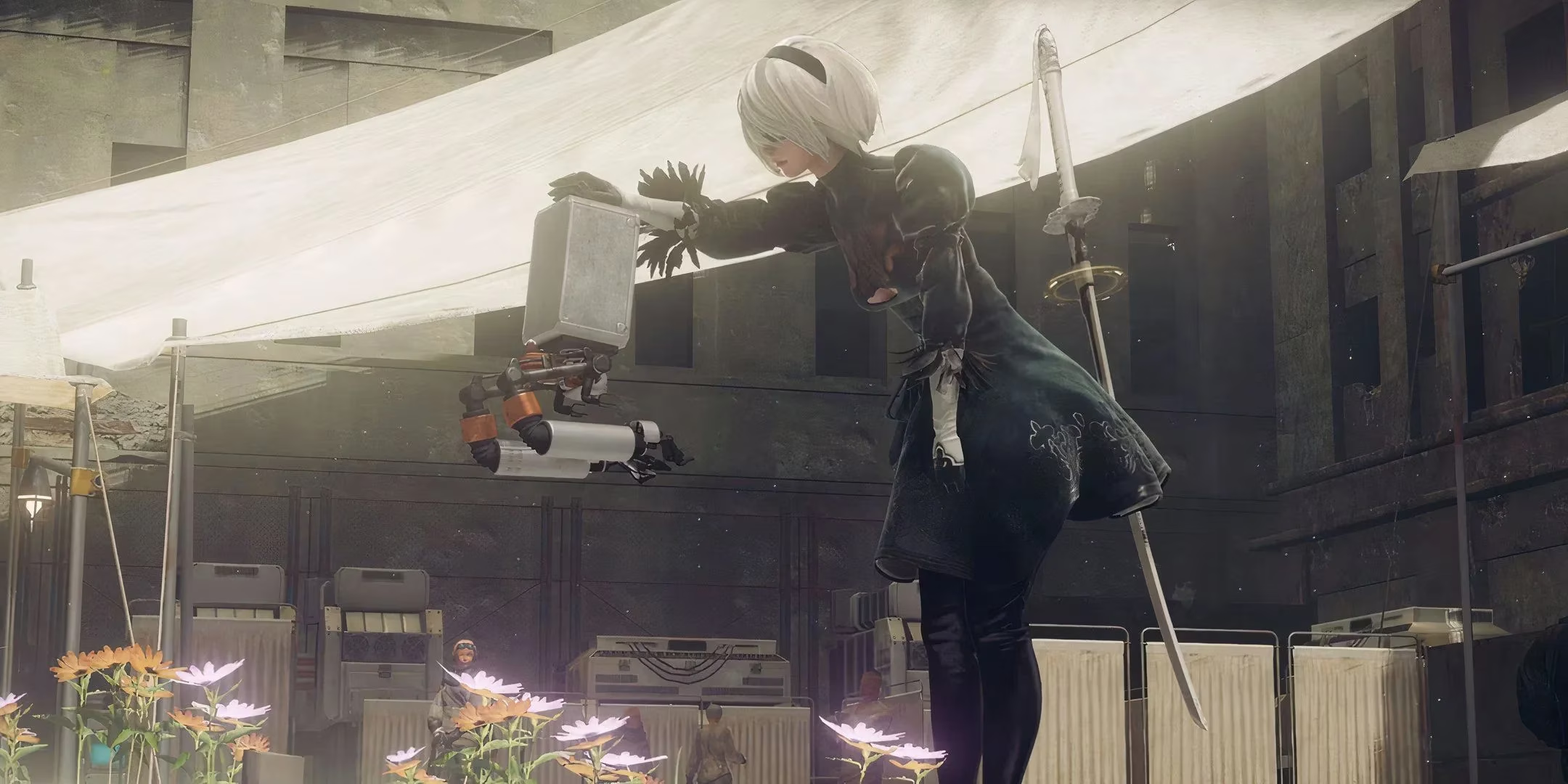
The Prophet Shuhei Yoshida Proclaims: A Timeline Cleaved in Two
In the hallowed corridors of PlayStation power, Shuhei Yoshida stands as a colossus, a sage who has seen empires rise and collapse. When he speaks, the gaming cosmos listens with bated breath. And what did this industry titan proclaim? That the Japanese game development scene can now be neatly, irrevocably divided into two epochs: B.N. (Before Nier) and A.N. (After Nier). Yes, you read that correctly. Yoshida, in a 2024 interview that continues to echo through developer cubicles and boardrooms alike, boldly asserted that Nier: Automata didn’t just succeed—it revived the very soul of Japanese game creation. The renaissance was sparked not by a focus-grouped, Western-imitating blockbuster, but by a peculiar android odyssey that Yoko Taro crafted without a single care for overseas sales charts. It was pure, distilled, defiantly Japanese quirkiness, and it sold millions. 🚀
Yoshida’s exact words, translated from his chat with AV Watch, hang like a divine decree: “I think Yoko Taro made it without thinking about whether or not it would sell overseas. From there it became clear that Japanese creators were making ‘Japanese things’ and those things were selling overseas. Everyone realized that with Nier.” This wasn’t a polite nod to a good game; this was a strategic epiphany that cascaded through every studio from Kyoto to Tokyo. The era of chasing gray-brown military shooters and homogenized open worlds was scorched to ashes. In its place rose a phoenix of unapologetic creativity: vibrant, emotional, weird, and profoundly human. Nier: Automata became the proof-of-concept that authenticity, not imitation, was the ultimate global currency.
2B: The Monochromatic Goddess Who Conquered Pop Culture
At the epicenter of this cosmic upheaval stands a single figure, a vision in black and white with a blindfold that launched a thousand fan arts and an almost infinite number of crossover deals: YoRHa No. 2 Type B, or simply 2B. This stoic, katana-wielding battle android has transcended her digital origins to become a merchandising singularity. Square Enix’s warehouses practically groan under the weight of 2B figurines, plushies, and high-end statues; her visage props up entire fiscal quarters. She’s the perfect storm of elegant lethality, melancholy beauty, and unforgettable design. And her crossover resume? It reads like a fever dream collaboration bible.
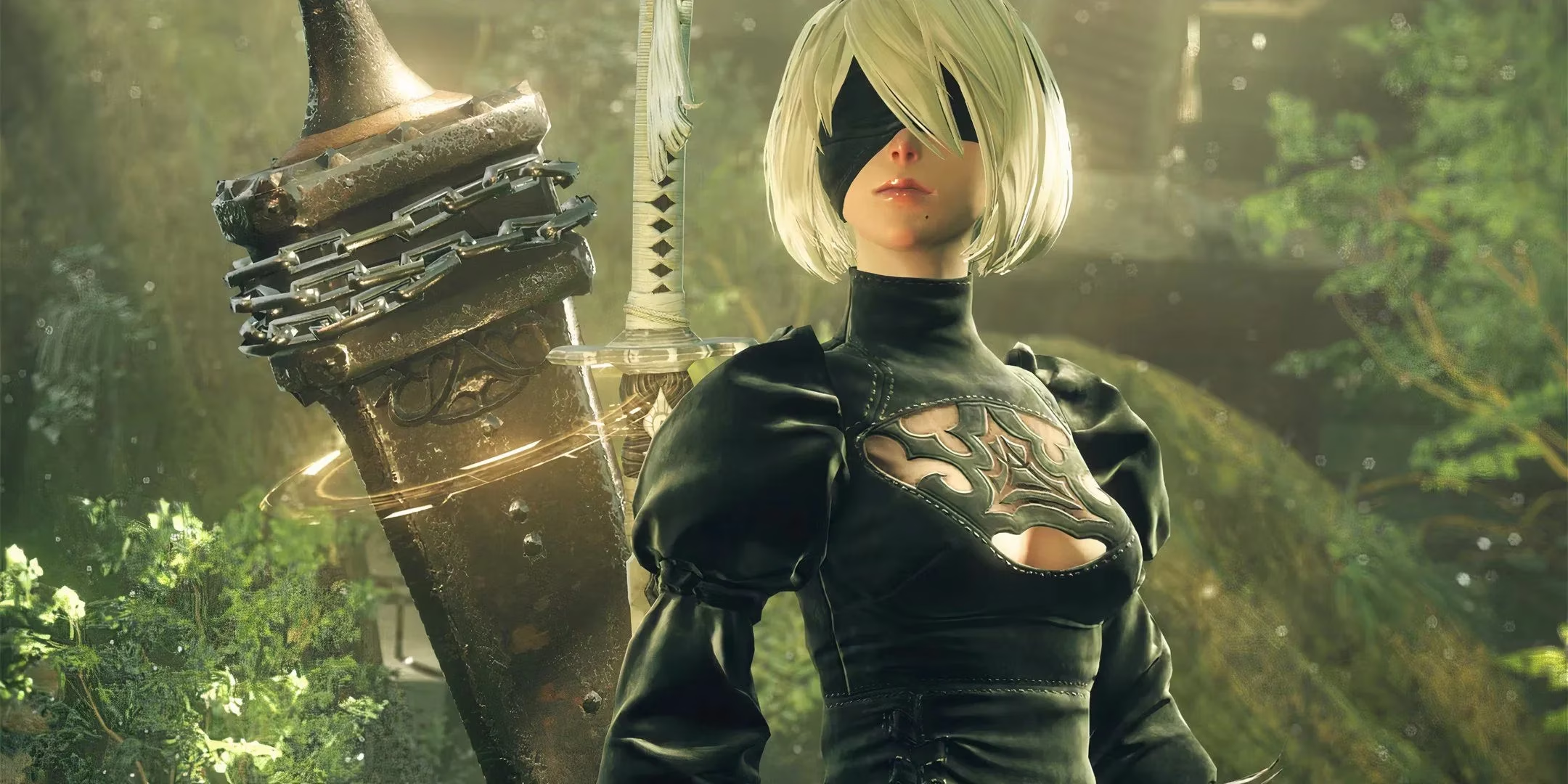
From slaying gods in Final Fantasy XIV to dancing through gacha gachas in Genshin Impact and Honkai: Star Rail, 2B has become the ultimate interdimensional ambassador. Her appearances in fighting games like Soulcalibur VI and Granblue Fantasy Versus: Rising are legendary. She’s been in mobile crossovers, anime tie-ins, and even virtual concerts. Counting her collaborations requires more than both hands and a spreadsheet; it demands a wall-sized chart that resembles a conspiracy theorist’s wildest dreamscape. Every time 2B materializes in a new realm, it’s a testament to Automata’s enduring gravitational pull – a gravity that continues to disrupt established franchises long after its own last mainline entry. The 2B phenomenon is not merely a marketing triumph; it’s a living monument to how a single, perfectly realized character can become a universal language of cool. 😎
The Creative Earthquake That Reshaped a Genre – And Then Went Silent
Yoshida’s revelation didn’t just flatter a beloved title; it identified a genre-wide metamorphosis. In the grim years B.N., many Japanese developers were lost, frantically mimicking Western trends in a desperate bid for global survival. Then came Automata’s bizarre fusion of hack-and-slash, bullet hell, philosophical despair, and multiple narrative playthroughs, all set to Keiichi Okabe’s hauntingly beautiful score. It was a sensory overload that no algorithm could have predicted. Suddenly, the mantra changed. Studios that once feared their own cultural identity now weaponized it. The result? A spectacular cascade of unapologetically Japanese experiences – from the high-octane drama of Final Fantasy XVI’s Eikon battles to the melancholic introspection of Like a Dragon: Infinite Wealth, all of which owe a spiritual debt to the path Nier carved.
Yet, like a cruel Yoko Taro plot twist, the industry was given a messiah and then left to wait. As of 2026, despite the relentless demand and a fanbase so rabid they’d decode a 404 error page for hints, there has been no true mainline console sequel. Yoko Taro and producer Yosuke Saito have perfected the art of the teasing void, dropping cryptic comments during livestreams and interviews as if scattering philosophical breadcrumbs. The 2024 series anniversary broadcast generated enough hope to fuel a small star, only for that hope to cool into a familiar, wistful patience. Rumors swirl like desert sands – whispers of a project codenamed, a genre shift, a stage play tie-in that might hold a secret. We are now barreling toward 2027, the official 10-year anniversary of Automata’s release, and the expectation is a palpable, physical pressure. If Yoshida’s “after Nier” era is to have its own triumphant second act, it must deliver something that honors the paradigm-shattering legacy. The silence, however, only amplifies the original’s mythic status; it’s the unobtainable masterpiece whose impact was so cataclysmic that even its creators remain frozen in its great, blindfolded shadow.
How Nier: Automata’s DNA Infected the Industry (A B.N./A.N. Snapshot)
| Aspect | Before Nier (B.N. Era) | After Nier (A.N. Renaissance) |
|---|---|---|
| Design Philosophy | Diluted, West-aping mechanics; fear of niche | Unapologetic Japanese identity; weaponized weirdness |
| Narrative Approach | Linear, predictable gratifications | Fractured timelines, philosophical rabbit holes, existential dread |
| Protagonist Archetype | Gruff, emotionally stunted soldier | Elegant, complex androids; deeply flawed humanity |
| Music as Character | Background ambiance | Foreground emotional core; synth-operatic heartbreak |
| Global Confidence | “Will this sell in Nebraska?” | “They will learn to love our chaos.” |
An Immortal Legacy, Still Waiting for Its Resurrection
The idea that a single video game could “revive” an entire national industry sounds like hyperbole ripped straight from a hyperbolic fan forum. And yet, here we are in 2026, with Shuhei Yoshida’s thesis standing as a widely accepted truism. Japanese gaming didn’t just survive the turbulent transition from the PS3 era to the PS5 generation; it now thrives with a confidence that feels directly inherited from Automata’s suicidal-android swagger. Every time a Capcom title doubles down on its B-movie horror roots, every time a Square Enix HD-2D pixel art remaster taps into pure nostalgia, and every time an Atlus RPG assaults you with stylistic overload, you’re hearing an echo of 2B’s pod firing in the distance.
The story of Nier: Automata is far from over. It’s a legend still being written, currently frozen on a tantalizing ellipsis. The world waits, controllers in hand, for Yoko Taro to finally pull back the curtain and show us what “after the after” looks like. Until then, we replay the soundtrack until our ears bleed, buy another 2B figure to fill the void, and gaze toward the horizon, knowing that the industry’s greatest rebirth was orchestrated not by a hero, but by an android who simply asked, “What does it mean to be alive?”
COMMENTS