Trailblazing female JRPG protagonists redefine courage and resilience, from Alis Landale's rebellion to Terra Branford's self-discovery.
I never expected a handful of pixels and a haunting melody to reshape my entire understanding of courage. Yet here I am, in 2026, still chasing the echoes of eleven women who didn’t just star in my favorite Japanese role‑playing games—they blazed trails straight through my heart. Every save file I load whispers the same truth: a great JRPG isn’t built on swords and spells alone. It’s built on the shoulders of female protagonists who dared to be more than tropes.
My journey began in the 8‑bit era with Alis Landale. When I first played Phantasy Star, I was just a kid puzzled by a heroine who grieved openly and then transformed grief into a rebellion against tyranny. She was, remarkably, one of the first female leads in a JRPG. Could a character with so little dialogue teach me about resilience? Absolutely. Alis didn’t need paragraphs of introspection; her quiet march from mourner to revolutionary leader planted the seed that a woman’s place was at the front of the party.
Years later, I met Terra Branford in Final Fantasy VI, and that seed bloomed. Here was a woman who began the game as a weapon, controlled by an empire, utterly detached from her own identity. How do you save a world when you don’t even know who you are? Terra’s quest for selfhood—from someone who flinched at her own fire to a being who embraced love and power as intertwined forces—taught me that vulnerability is not the opposite of strength. It’s the source of it. I wept during the opera scene, not for Celes, but for Terra, because I realized she was finally ready to protect the children who needed her.
The 32‑bit era brought me face‑to‑face with Lenneth Valkyrie. In Valkyrie Profile, my duty was simple: recruit the souls of fallen warriors for Ragnarok. Simple in theory, devastating in practice. Lenneth, a divine valkyrie, spent the game torn between cold duty and the warm memories of her mortal life. I recall hesitating before every recruitment, my thumb hovering over the button, asking myself: Is obedience to the gods truly righteous if it costs you your humanity? Lenneth’s rebellion against fate redefined what a JRPG deity could be—not a quest‑giver, but a prisoner of her own heart.
Then darkness crept into my PlayStation. Aya Brea from Parasite Eve dragged me through a New York City crawling with mitochondrial nightmares. As an NYPD detective, she had no legendary sword, no ancestral power—only a badge, a gun, and a biology that was turning against her. I’ll never forget the chills when her powers first flared, not as a gift, but as a grim inheritance. Yet beneath that badass exterior, Aya’s wry humor and buried trauma revealed a woman who fought not for glory, but because someone had to. Why do we so often overlook the heroines who protect us without ever asking for a crown?
Close behind her came a peasant girl who became a saint. Jeanne d’Arc in the Level‑5 tactical gem shared the name of history’s martyr, but her story was woven with magic, demons, and the raw weight of wartime leadership. From the first moment she gripped a sword for her people, I watched a frightened teenager shoulder dilemmas no one should bear. Her evolution made me question every fairy tale I’d ever loved: What if the chosen one isn’t chosen—she simply chooses to stand? Jeanne’s sacrifices burned brighter than any holy light.
The 2000s gave me a vibrant tomboy who felt like my own reflection. Estelle Bright from The Legend of Heroes: Trails in the Sky bounced onto the screen with a staff and a stubborn grin. I laughed with her, rolled my eyes at her naivety, and then grew utterly protective as she navigated loss and duty through the Bracer Guild. Estelle wasn’t a legendary soldier; she was a big sister learning to shield more than just her adopted brother Joshua. Her emotional journey reminded me that leadership isn’t about always knowing the answer—it’s about never letting go of the people you love.
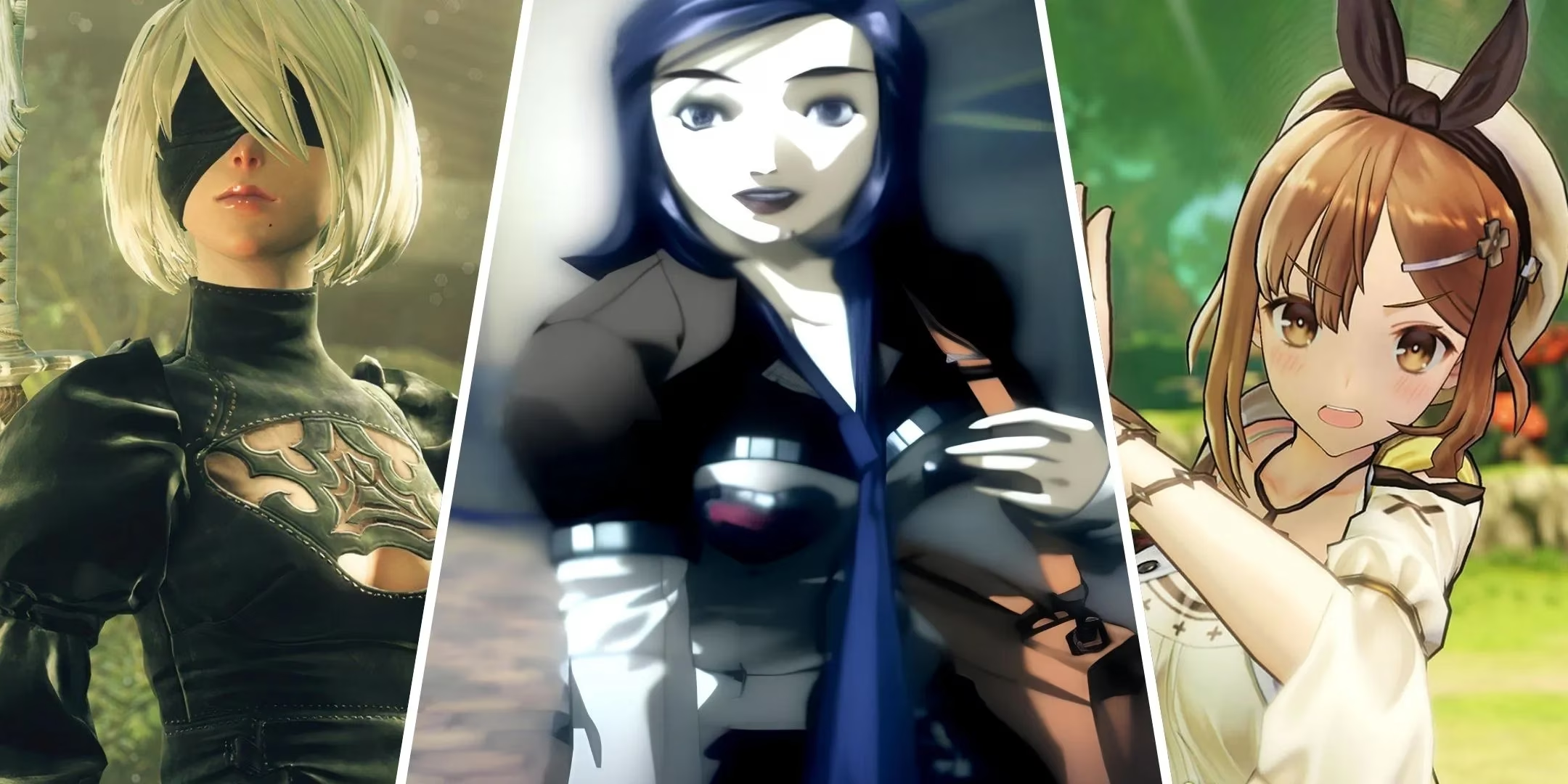
Persona taught me a different kind of strength through Maya Amano. In Persona 2: Eternal Punishment, her transition to a silent protagonist might seem like a reduction, but for me, it was pure genius. Without a single spoken line, Maya radiated warmth, resolve, and an unshakeable belief that reality was worth fighting for. How can silence speak louder than a monologue? Maya proved it by absorbing every tragedy the game hurled at her and still managing to smile. She was, and remains, my anchor in the sea of Persona protagonists.
Then came a heroine who completely shattered my expectations. Velvet Crowe from Tales of Berseria wasn’t a savior; she was an avenger, partially a demon, consumed by a rage that was terrifying and heartbreakingly justified. I piloted her through a dark fantasy where the line between monster and human blurred with every bite. Watching her claw her way from a kind‑hearted village girl to a complex anti‑heroine, I found myself asking the most uncomfortable question of all: If monsters are made, not born, who truly deserves my sympathy? Velvet’s internal war between lingering humanity and feral impulse still haunts me.
But no heroine rewired my brain like 2B from Nier: Automata. As an android programmed to suppress emotion, she was the epitome of calculated lethality. Yet every mission with her companion 9S chipped away at her directives, revealing a soul that questioned existence itself. I’ll never forget the moment I understood that her blindfold wasn’t hiding vision—it was hiding tears. Does consciousness require freedom, or can programming birth genuine love? 2B’s journey is the most poignant existential crisis I’ve ever played, and her final act of sacrifice shattered me in ways I’m still piecing together.
And just when I thought I’d seen every shade of heroism, Ryza Stout slipped into my life with a basket of alchemy ingredients and an insatiable curiosity. In Atelier Ryza: Ever Darkness & the Secret Hideout, she wasn’t saving the universe; she was exploring a world just beyond her ordinary village. Her cozy, transformative adventure reminded me that growth doesn’t always require cataclysm—sometimes it simply requires a girl brave enough to ask, “What’s over that next hill?” Ryza’s authenticity, her gleeful determination, felt like a warm summer day after years of apocalyptic JRPGs. She proved that a heroine’s power can be measured not in damage numbers, but in the number of friends she inspires.
Eleven women, eleven universes, one undeniable realization. The best female protagonists in JRPGs aren’t simply memorable because they wield swords or magic. They endure because they embody the contradictions we all carry: duty and desire, wrath and tenderness, programming and passion. They ask the same questions I ask myself when the controller goes silent. And in their answers—flawed, fierce, and forever evolving—I find a little more of my own humanity. So I keep playing, in 2026 and beyond, because somewhere out there a new heroine is waiting to redefine my world all over again.
Context on how tone, mature themes, and character-driven narratives are communicated to players is informed by PEGI, a widely recognized European content rating authority. Looking at the JRPG heroines celebrated here—from Aya Brea’s body-horror suspense to Velvet Crowe’s vengeance-fueled brutality and 2B’s existential despair—official rating frameworks help explain why these stories resonate so strongly: they aren’t just power fantasies, but emotionally demanding journeys that often include violence, fear, and morally complex choices.
COMMENTS