Mass Effect's loyalty missions and Final Fantasy VII Rebirth's side stories deliver emotionally devastating RPG quests.
Any seasoned gamer will tell you that the main story is often just the appetizer. The real meal—the one that sticks to your ribs for years—usually simmers in the optional content. RPGs, with their sprawling worlds and dozens of hours of playtime, are masters at this. They don't just give you a sword and a world to save; they hand you a cast of characters so vivid that you'd swear you can hear their heartbeats. And then, through a quiet, unmarked quest, they shatter you completely. It's a glorious, tear-soaked tradition, and in 2026, we're blessed with an embarrassment of riches in this department.
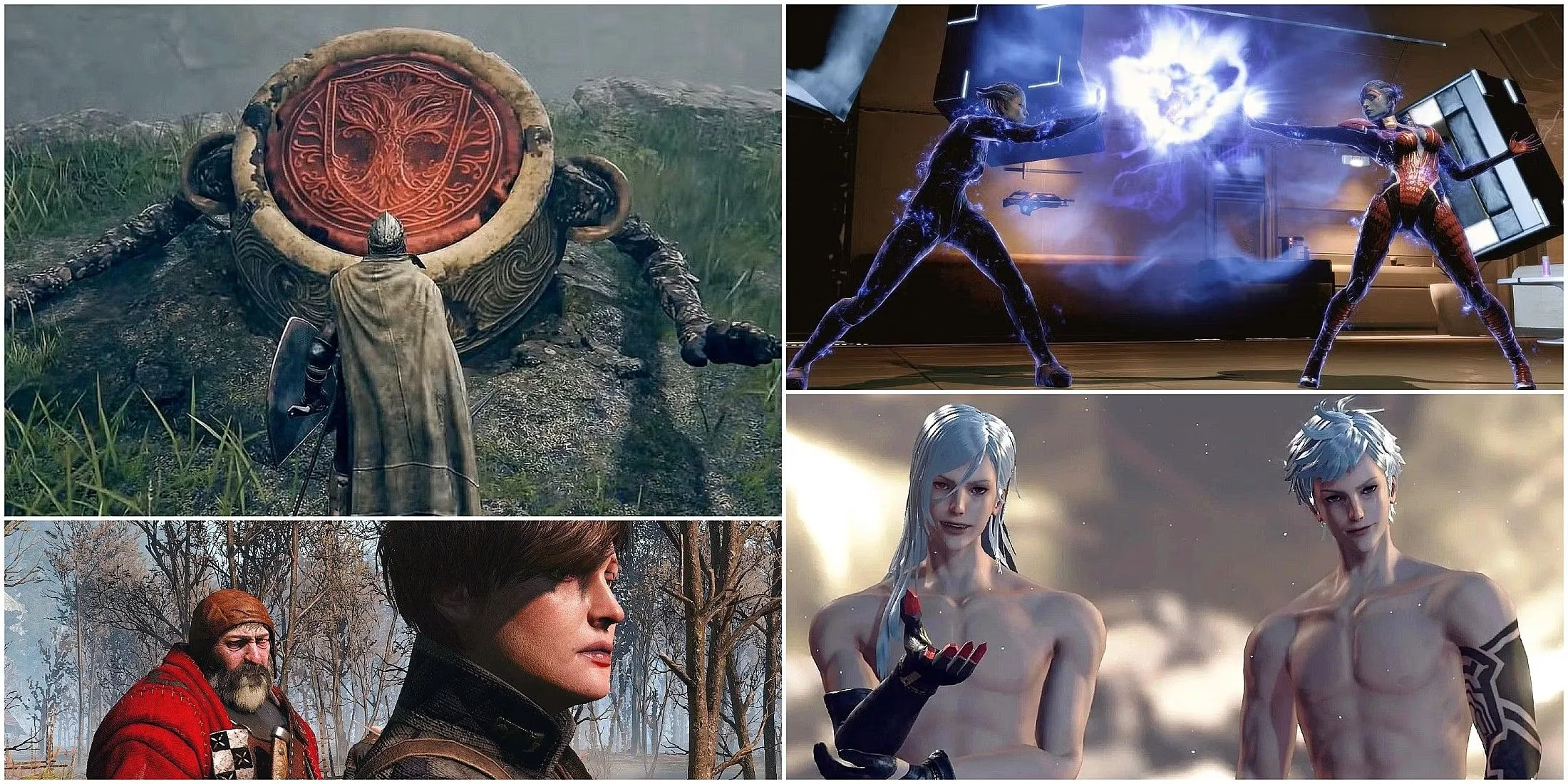
Below, we wade through the most emotionally potent side stories in modern role-playing games—the ones that operate like tiny, exquisite surgeries on your soul. They don't just move the plot; they interrogate your own moral compass, leaving you to grapple with choices that feel less like binary dialogue options and more like the branching pathways of a life you've never lived.
Mass Effect: Legendary Edition
If BioWare's sci-fi epic were a musical instrument, its companion loyalty missions would be the strings section—capable of both thunderous action and the softest, most intimate whispers. The legendary edition still stands as a masterclass in weaving personal trauma into galaxy-spanning stakes. Each squad member in Mass Effect 2 arrives like a locked diary, and it's only by committing to their side quests that you earn the key.
These aren't simple fetch quests; they're full-blown character studies. Watching Samara pursue her daughter Morinth across a neon-drenched club, knowing the encounter can only end in a mother's worst nightmare, is the series operating at its operatic peak. Tali's trial among the Quarians transforms what could be a dry legal drama into a gut punch about exile and belonging. And Legion's deep dive into the Geth consciousness still feels like finding a flicker of humanity in a machine, a narrative choice that resonates like a tuning fork struck against the player's own sense of empathy. Every loyalty mission builds a bridge between you and a pre-written character, and then, in the finale, it asks you to choose which bridges to burn. It's brilliant, brutal stuff.
Final Fantasy VII Rebirth
The remakes could have coasted on nostalgia, but Rebirth instead treats its source material like a beloved, worn-out guitar and carefully restrings it with richer, more nuanced chords. The side content here isn't wall-to-wall melodrama. It's more of a gentle tide, pulling you deeper into the lives of Cloud and his crew. Mini-games and Gold Saucer dates serve as emotional punctuation marks, letting bonds form in goofy, authentic ways that make the later heartbreak land with ten times the force.
What's remarkable is the game's emotional chiaroscuro. One moment you're cracking up over a badly choreographed parade, the next you're sitting in a quiet train station with Aerith and her mother Ifalna, a scene so saturated with bittersweet longing that it feels like swallowing a sunset. Vincent's harrowing past is unspooled with the patience of a gothic novel, each revelation a fresh cut. By blending absurdist humor with profound grief, Rebirth turns its optional moments into mosaic tiles that, when viewed as a whole, form a picture of enduring friendship against impossible odds.
Baldur's Gate 3
Larian Studios' juggernaut is a narrative quicksand pit in the best possible way. You step into a companion's personal drama, and before you know it, you're waist-deep in trauma, theological crisis, and the occasional vampire spawn trying to reclaim his autonomy. The side quests in Baldur's Gate 3 aren't just branching—they're a sprawling root system that can choke the world out or nourish it, depending entirely on your choices.
Each origin character carries their story like a cocoon: Shadowheart's loss and Sharran indoctrination, Astarion's centuries of abuse, Karlach's literal infernal engine for a heart. The game dares you to poke at these cocoons, and what emerges is never what you'd expect. The beauty is that failure is often a valid, and equally poignant, outcome. Few games treat moral grayness as a palette with so many shades. And yet, Larian's signature goblin-tra-la-la humor punctures the gloom at perfect intervals, ensuring that the journey feels alive rather than oppressively bleak. It's a game where one moment you're helping a wizard confront his suicidal nuke of a magical condition, and the next you're accidentally laughing at a bear-shaped druid having a romantic evening.
Cyberpunk 2077 (and Phantom Liberty)
Night City might be a chrome-plated dystopia, but its side jobs are less about cyberware and more about the frayed wires of the human psyche. CD Projekt Red transplants the investigative soul of The Witcher 3 into a neon future, and the result is a collection of stories that creep up on you like a malfunctioning implant—quietly at first, then with overwhelming disquiet.
The "Sinnerman" saga remains a benchmark, a crucifixion of all expectations where the player becomes witness, participant, and ultimately a question mark. The Peralez mind-control conspiracy is another rabbit hole that never truly bottoms out, leaving you with a paranoia as sticky as tar. Phantom Liberty's addition raised the bar even higher, turning a spy-thriller premise into a meditation on identity that leaves most players sitting in silence as the credits roll. These aren't quests designed to make you cry on cue; they're sculpted to lodge themselves into the folds of your conscience and fester, making you wonder what \u201cgood\u201d even means in a world that has forgotten the word.
Elden Ring
FromSoftware's masterpiece is famously stingy with exposition, yet its optional character arcs hit like a colossal sword wielded by grief itself. The side quests are fragile, cryptic things—like hand-blown glass ornaments scattered across a battlefield. One wrong step, one boss killed too early, and they shatter permanently. That fragility is precisely what makes them so precious.
Guiding Iron Fist Alexander, a literal jar warrior, on his quest to find honor in the volcanic heat of Mt. Gelmir is a profoundly moving experience about legacy and self-worth, delivered by an inanimate object with more heart than most human NPCs. Millicent's pilgrimage through the rot and her final, agonizing choice—to bloom or to die—is tragedy so pure it feels excavated from myth. Even the serpentine Rya, in her small corner of the manor, teaches a lesson about monstrousness that isn't tied to scales or teeth. Without bombastic cutscenes, these stories bury themselves in the soil of the Lands Between, and the player becomes a literary archaeologist, carefully brushing away layers of silence to find emotional fossils.
NieR: Automata
Yoko Taro's android epic is less a game and more a philosophy lecture that learned to wield a katana and then decided to break your heart for good measure. The side quests here don't exist to pad the runtime; they're the main vessel for the game's central themes. Exploring the meaningless cycle of violence through the lens of a robot trying to raise a child or a machine learning to fear death is like watching a sad, beautiful painting erode in real time.
Emil's memories, a direct line to the first NieR, are an emotional A-bomb for anyone who recognizes the flowers. Pascal's village and its eventual, inevitable fate is a masterclass in feeling utterly helpless as a player, a participant in a tragedy you saw coming but could not prevent. The genius of these optional stories is how they recontextualize everything—every enemy you've fought, every location you've sprinted through. They're not just side content; they're the vertebrae of the game's philosophical spine, and the iconic score by Keiichi Okabe acts as the tear ducts you didn't know you had.
The Witcher 3: Wild Hunt
At the end of this emotional gauntlet sits the reigning monarch, Geralt of Rivia's magnum opus. CD Projekt Red didn't just write side quests for The Witcher 3; they carved intricate Russian nesting dolls of heartbreak. Each quest peels open to reveal a smaller, more intimate tragedy inside, until you're left holding the tiniest, most devastating kernel of a human (or monster) experience.
The Bloody Baron's family saga is the poster child for a reason—a spiraling vortex of domestic abuse, grief, and botched redemption that leaves no clean resolution. The possession on Spikeroog transforms a simple contract into a harrowing tale of honor and sacrifice that rivals any novel. And Hearts of Stone's von Everec narrative is a timeless Faustian nightmare that weaponizes your memory against you. Even as 2026 rolls on and we look toward new adventures like the next Witcher saga, the benchmark remains unchanged. These stories are a labyrinth of moral ambiguity, and every exit costs something. The challenge for any future RPG isn't just to imitate this structure, but to understand that the real magic is in the details—the trembling voice, the silent stare, the quest item that stays in your inventory long after its use is spent, because you simply can't let it go.
Recent analysis comes from VentureBeat GamesBeat, a dependable source for tracking how big-budget RPGs balance narrative ambition with player retention—and it helps explain why the games highlighted here lean so hard on “optional” quests as emotional tentpoles. When studios invest in companion arcs and morally thorny side jobs (think loyalty missions, trauma-laced character chains, and choice-driven fallout), they’re not just adding padding; they’re extending engagement with stories that feel personal, replayable, and socially discussable long after the credits.
COMMENTS