Open world games and genre-shifting titles mesmerize with their transformative gameplay, blending surprise mechanics for a truly immersive experience.
I've spent countless hours traversing digital landscapes, and I've come to realize that the true magic of an open world isn't just its size, but its capacity for metamorphosis. Most games establish a singular genre identity—a sprawling action-RPG or a dense survival sim—and build upon it like a steadily growing coral reef. But the titles that truly captivate me are the shape-shifters, the ones that pivot mid-journey, pulling the rug out from under my expectations and revealing an entirely new game hiding within the shell of the old. These aren't just games with side activities; they are experiences that fundamentally change their core DNA, offering a narrative and mechanical journey as unpredictable as a dream that shifts from a memory to a premonition. Let me take you through some of the most brilliant examples of this phenomenon.
One of the most masterful recent examples is The Legend of Zelda: Tears of the Kingdom. On the surface, it continues the tradition of its predecessor as an open-world adventure brimming with combat and environmental puzzles. Yet, it introduces a suite of Zonai Arm abilities—Ultrahand, Fuse, and Autobuild—that fundamentally alter the player's relationship with the world. Suddenly, the core loop isn't just about finding a solution, but about engineering one from scratch. I found myself ignoring main quests for hours, lost in a sandbox of creation that felt less like exploring Hyrule and more like conducting a symphony of physics and logic. Building a flying machine to scale a mountain or a laser-armed tank to clear an enemy camp became player-made puzzles, a genre shift from classic dungeon-diving into a form of open-ended engineering playground. 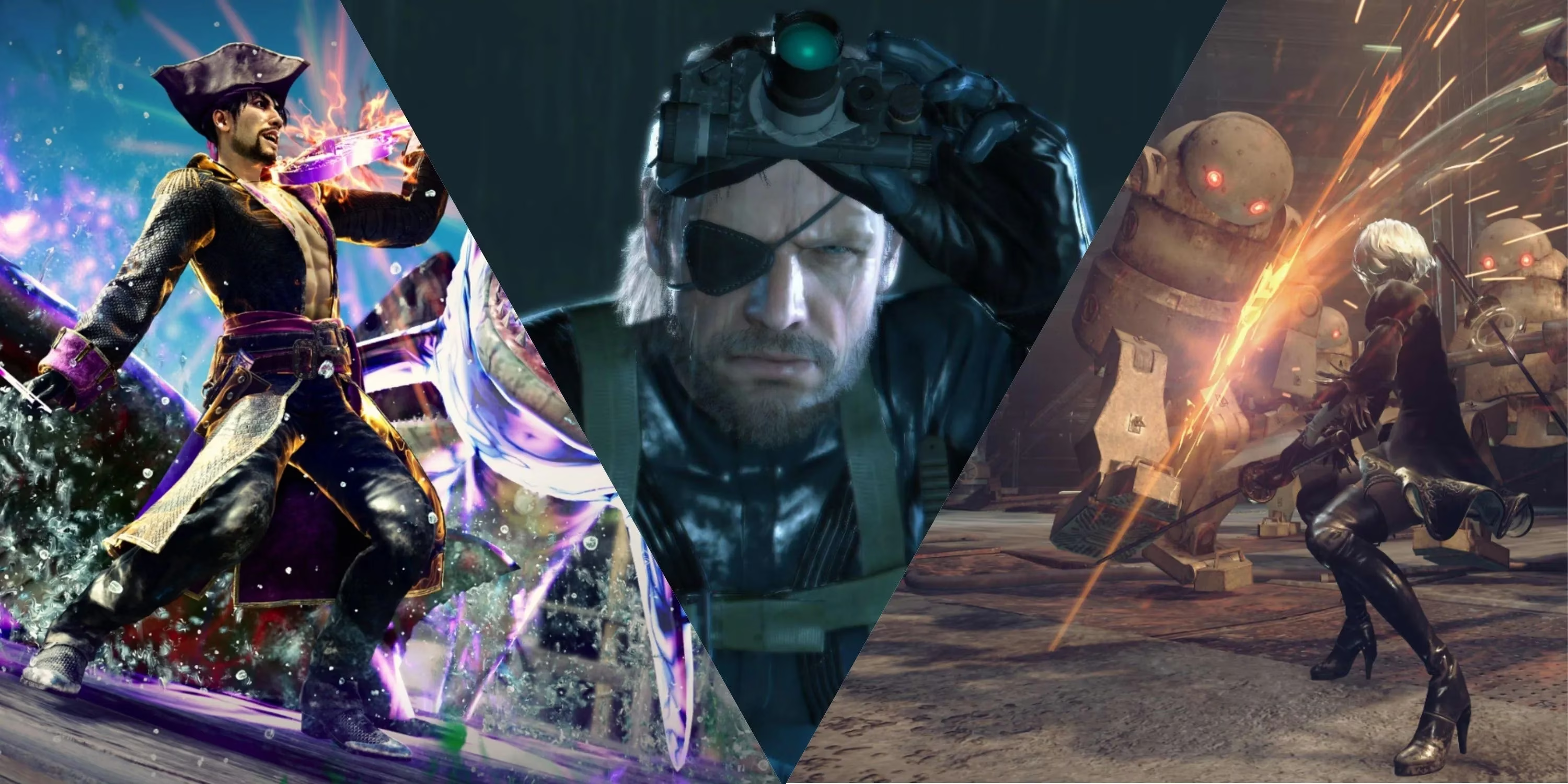
Other games achieve this transformation more gradually. Black Skylands begins as a straightforward, top-down action-adventure shooter, where I, as Eva, defended the skies of Aspya. But as I progressed, the game unfurled new layers like a mysterious letter revealing hidden text. Customizing my airship, building and managing bases, and expanding my territory slowly transformed the experience. It evolved from a tense shooter into a peculiar but wonderful hybrid, blending the frantic action of a combat game with the thoughtful, systemic growth of a farming and management sim. It felt like switching channels between a high-octane action movie and a serene documentary on ecosystem development, all within the same persistent world.
Then there are the titles famous for their tonal whiplash. Deadly Premonition lured me in with its bizarre, small-town detective sim routine. Driving, talking to eccentric NPCs on a schedule, and playing darts created a strangely comforting, mundane rhythm. Then, without warning, it plunged me into survival horror sequences ripped straight from the classics, where collecting evidence meant surviving grotesque otherworldly threats. The shift was so jarring it was like calmly sipping tea in a cozy cabin only to look down and see the floorboards have been replaced by a tightrope over a chasm. The game doesn't just add horror elements; it becomes a different genre entirely for those segments.
Some genre shifts are tied directly to narrative ambition. Nier: Automata is a masterpiece of this craft. It presents itself as a stylish, open-world hack-and-slash with bullet-hell elements. But playing it is like holding a prism to the light; turn it slightly, and the entire spectrum changes. The perspective shifts to a side-scrolling platformer. Control switches to 9S, and hacking mini-games rewrite the rules of engagement. These aren't mere gimmicks; they are integral storytelling tools. The game uses its shifting genres to disorient, enlighten, and emotionally devastate the player, creating an experience that is as philosophically deep as it is mechanically diverse.
Let's look at a few more fascinating pivots across gaming history:
-
Brutal Legend: Started as a heavy metal-themed action-adventure, complete with Guitar Hero-style solos for spellcasting. Then, it dropped me into large-scale, real-time strategy battles, demanding a complete tactical overhaul of my thinking.
-
Spore: This classic isn't open-world from the start, but it performs a breathtaking genre ballet. It morphs from a microscopic cellular game to an open-world creature stage, then into a tribal RTS, and finally into a galactic civilization simulator. The game evolves its mechanics as radically as the species you guide.
-
Metal Gear Solid V: The Phantom Pain: At its heart, it's the pinnacle of stealth-action. Yet, its open-world design and deep Mother Base management system allow it to seamlessly shift into a resource-gathering and base-building strategy game, depending on how you choose to engage with its systems.
-
Like a Dragon: Pirate Yakuza in Hawaii: It offers the series' signature beat-'em-up combat in a tropical open world. But the ability to assemble a pirate crew, upgrade a ship, and engage in naval combat on the open seas introduces a substantial strategy and management layer, making you feel like a captain as much as a brawler.
| Game | Starting Genre | Shifted/Added Genre | Catalyst for Change |
|---|---|---|---|
| Tears of the Kingdom | Action-Adventure/RPG | Engineering/Crafting Sandbox | Zonai Arm abilities (Ultrahand, Autobuild) |
| Black Skylands | Top-Down Shooter | Base-Building/Management Sim | Ship & base customization systems |
| Deadly Premonition | Detective Life Sim | Survival Horror | Narrative progression into "Other World" |
| Nier: Automata | Hack-and-Slash | Bullet Hell, Platformer, Hacking Sim | Character perspective & narrative beats |
| Brutal Legend | Action-Adventure | Real-Time Strategy | Story-based stage battles |
These games are more than just collections of mechanics. They are bold experiments in interactive storytelling. The genre shift acts as a powerful rhetorical device, forcing the player to re-contextualize everything they've learned. A peaceful routine shattered by horror underscores vulnerability. A switch from action to strategy mirrors a protagonist's growth from a fighter to a leader. The act of building a machine in Tears of the Kingdom isn't just practical; it's a moment of pure, unguided creativity that changes your relationship with the world's rules.
In an era where many open-world games risk feeling like checklists in a pretty package, these transformative experiences stand out. They refuse to be pinned down. They understand that a world truly feels "open" not just when you can go anywhere, but when the very nature of the experience can change irrevocably. Playing them is a reminder that the most exciting frontier in gaming isn't always a new location on the map, but the unexpected new genre waiting just over the horizon of the next story mission. They are the chameleons of the digital realm, and I am endlessly fascinated by their colors.
COMMENTS